Nepal’s new government, our year of work, and what comes next
A note from Sujeev

Sujeev Shakya, CEO, beed
The last ten months in Nepal have felt like a decade. It reminds me of 2008, the year Nepal elected its first Constituent Assembly to write a new constitution for a Federal Democratic Republic. A decade-long insurgency had just ended, power was being devolved to local governments, and a Hindu kingdom was becoming a secular republic. We lived a decade of change in those two years.
That same year, I wrote Unleashing Nepal: Past, Present and Future, setting out the economic opportunities the moment presented. It was also the year beed started, as one of the first management consulting firms working in and outside Nepal. beed’s purpose, from the beginning, was to help organizations, profit and not-for-profit, national and global, understand what lies ahead for Nepal. Watching many of those early ideas come to fruition has been one of the most rewarding parts of building this firm.
We find ourselves in a similar moment now, seventeen years and multiple countries across Asia and Africa later. My book Nepal 2043: Road to Prosperity, released last August, has become something of a guiding document for how we think about beed’s work. We have long talked about Nepal’s political transformation failing to keep pace with its economic transformation. The feeling today is déjà vu. We called it New Nepal then. Perhaps what we are looking at now is New Nepal 2.0, and Reforms 2.0 to go with it.
Nepal: what changed this year
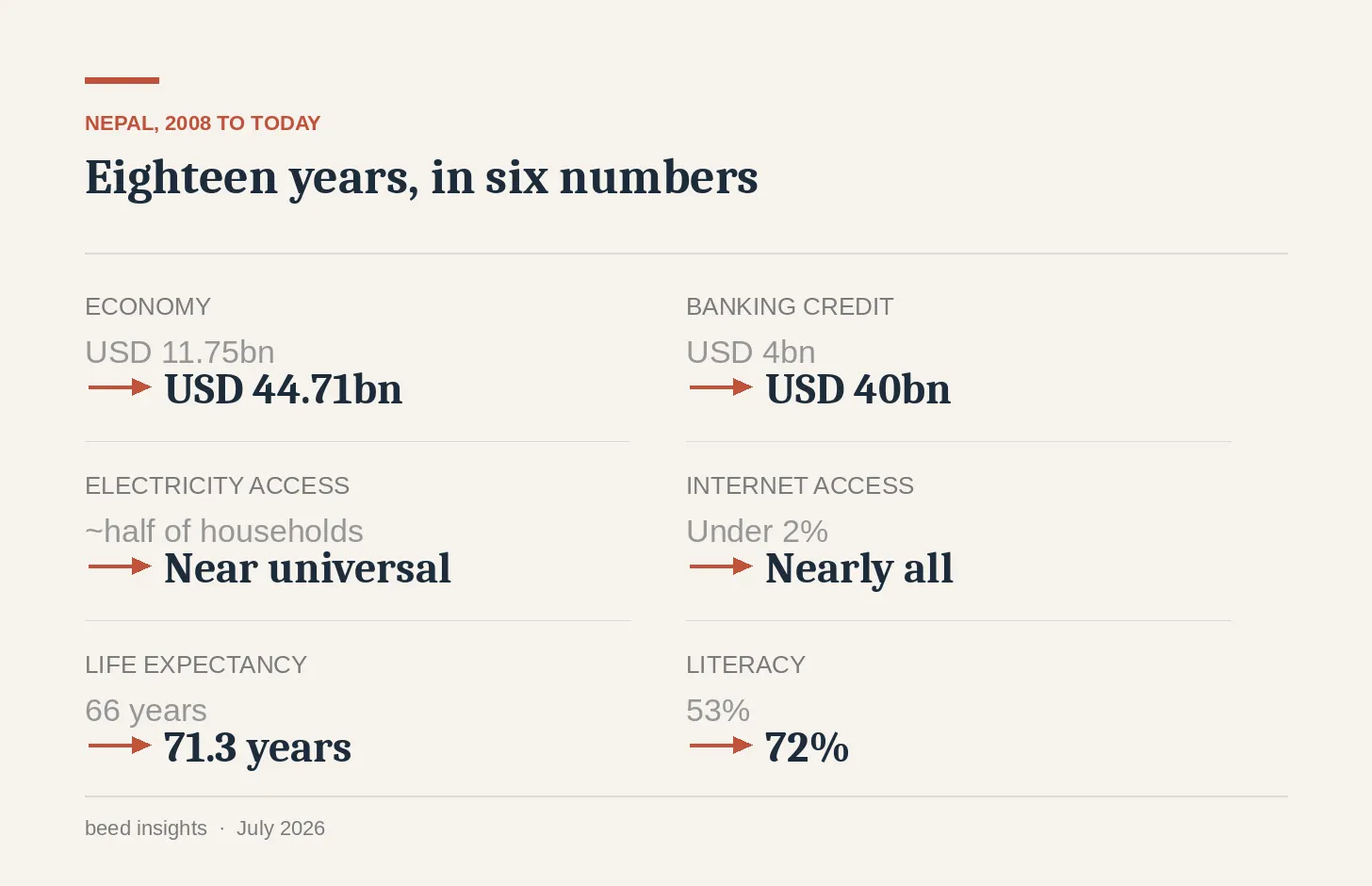
Comparing 2008 to today, the data tell their own story. Nepal’s economy grew nearly fourfold, from USD 11.75 billion to USD 44.71 billion. Electricity access went from roughly half of households to almost universal, and internet from less than 2% of the population to nearly all of it. Banking credit grew tenfold, from USD 4 billion to USD 40 billion. Social indicators moved in step: life expectancy rose from 66 to 71.3 years, and literacy from 53% to 72%.
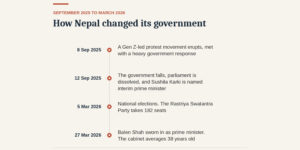
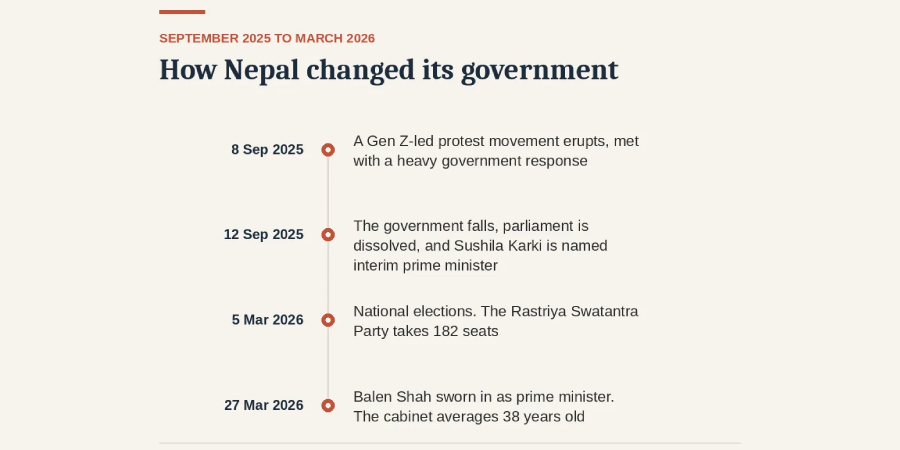
The past ten months brought their own turn of events. A Gen Z-led protest movement, met initially with a heavy government response, led to the collapse of the government and the dissolution of parliament. An interim government led by former Chief Justice Sushila Karki restored stability and oversaw national elections in March 2026. The Rastriya Swatantra Party, formed only in 2022, won a commanding majority, taking 182 seats, two short of a two-thirds majority. A new government under Prime Minister Balen Shah took office at the end of March, announcing sweeping administrative reforms, arrests of politicians and business figures accused of corruption, and a renewed emphasis on efficient public service delivery. The cabinet sworn in had an average age of 38 at formation, with Finance Minister Swarnim Wagle the oldest at 51.
The cabinet sworn in had an average age of 38, with the Finance Minister the oldest at 51.
The new government has announced a 100-point program and an 18-point agenda drawing together the aspirations of Nepal’s political parties, with a stated focus on better governance, eliminating corruption, creating jobs, and accelerating growth. Finance Minister Swarnim Wagle presented the budget for 2025/26: USD 13.89 billion in total spending, with USD 8.31 billion for recurrent expenditure, USD 2.82 billion for capital investment, and USD 2.76 billion for debt servicing. The budget cut some taxes while widening the tax net elsewhere.
A High-Level Commission on Reforms, formed in October 2024 and reporting in April 2025, has begun seeing its recommendations implemented, a process the current government has continued. The agenda centers on making it easier to start a business, bring in foreign capital and technology, and move procedures online, alongside incentives for job creation and import substitution. The government has committed to bringing the economy close to USD 100 billion within five years. With Nepal’s informal economy larger than its formal one, and GDP on a PPP basis already at USD 170 billion, that target is ambitious but not out of reach.
What we did this year
A few of the engagements from fiscal year 2081/82: a tourism board rethinking what growth means after a decade of chasing arrival numbers, a sector the UK barely has on its radar yet, and a migration corridor that’s grown fast with little structure behind it.
For Nepal Tourism Board, working with UNDP’s Sustainable Tourism Project, we built the international marketing strategy and five-year action plan meant to carry NTB through 2030. The diagnostic told us something NTB’s own numbers hadn’t said out loud: arrivals are back to 97% of pre-pandemic levels, but average daily visitor spend has dropped from USD 40.80 in 2024 to USD 33.09 in 2025. Volume recovered, value didn’t. We sat through more than 135 stakeholder interviews and focus groups to get there, and the resulting strategy rests on six pillars, the first of which is rebuilding NTB’s own capacity to market at all, currently running at little more than half the budget share the organization was originally set up with.
Volume recovered, value didn’t.

The beed team with long-time collaborators Lisa Choegyal and Nandini Thapa at
the final presentation of the Nepal Tourism Board’s International Marketing Strategy
and 5-Year Action Plan. Photo courtesy of Tourism Info Nepal.
For the British Embassy and the Department for Business and Trade, we scoped Nepal’s tech and IT-enabled services sector for UK businesses, a market most UK firms haven’t priced in yet. We came out with a sector worth roughly GBP 436 to 489 million today, on track to top GBP 1.5 billion by 2029, and a handful of subsectors, cybersecurity, fintech, govtech, and applied AI, where Nepal’s demand and the UK’s strengths actually line up. Fourteen Nepali firms showed up at last year’s London Tech Week. That’s the kind of detail that tells you the relationship is already starting, just not yet organized.
For the EU Delegation, working closely with Nepal Economic Forum (NEF), our sister policy research organization, we ran the first real diagnostic of Nepal’s migration corridor to Europe: field visits across eight countries, more than 60 interviews, and three separate surveys covering prospective migrants, the households they leave behind, and Nepalis already there. Labor permits to Europe went from 4,585 in 2016/17 to 77,181 last year. We think the real figure on the ground, counting everyone, is closer to half a million. The fix starts with something as basic as language training: two in three people leave without speaking a word of the language they’re moving to.
Two in three people leave without speaking a word of the language they’re moving to.
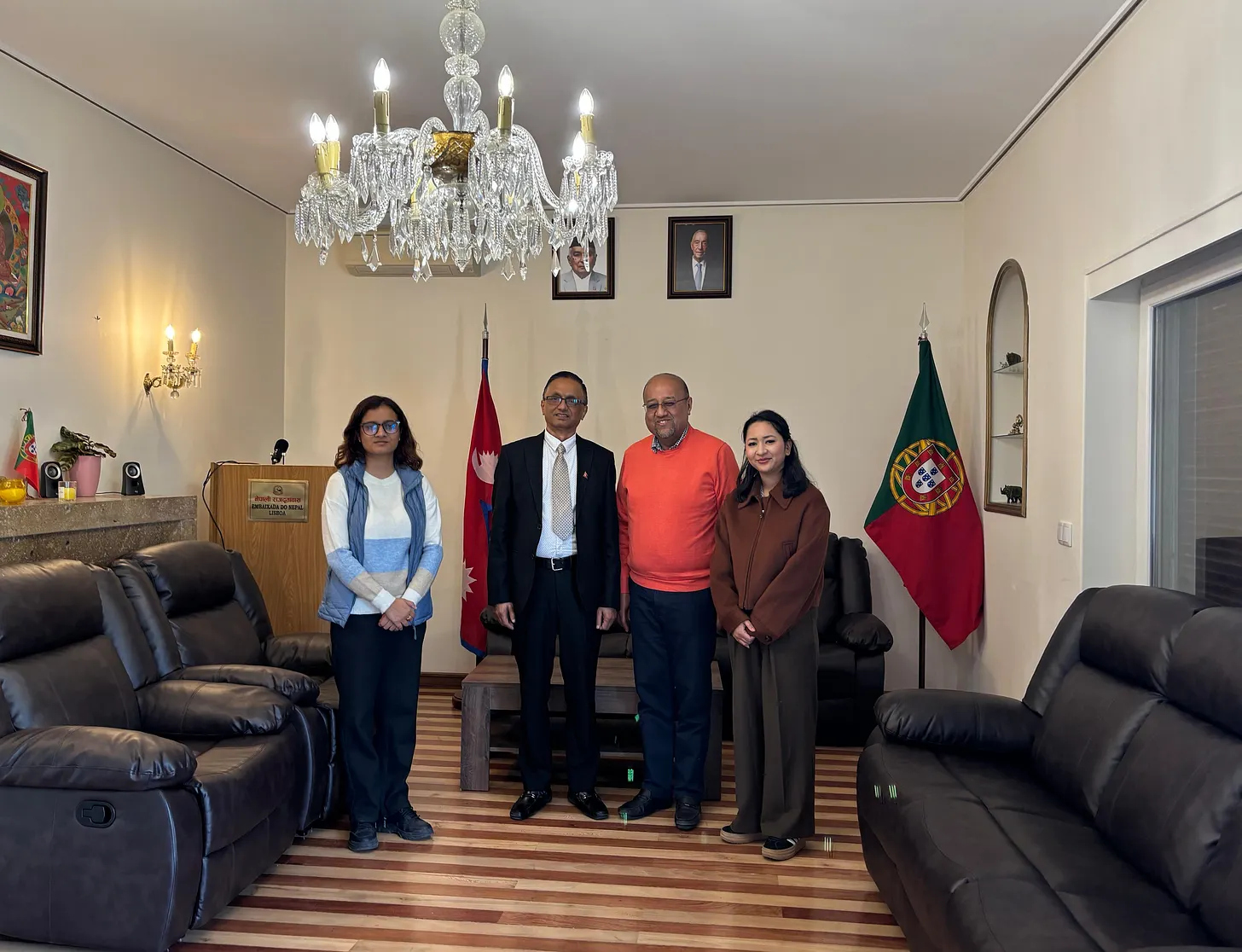
With H.E. Mr. Prakash Mani Paudel, Ambassador of Nepal to Portugal, during
fieldwork for the EU migration corridor study.
These are three of more than 225 projects we have delivered across ten countries over the past seventeen years. A significant part of that work has been with diplomatic missions trying to understand Nepal, the Australian, Swiss, Thai, and EU delegations among the most recent. It runs through a network of over 150 alumni, many of whom came up through NEF’s internship and fellowship programs and now work around the world, alongside collaborators and firms who help us bring global practice to a Nepali context. That combination of experience and network is what we bring to whatever comes next.
What we’re watching
We see this moment in Nepal as an opportunity, not just a disruption to manage. With Nepal landlinked between the fastest-growing major economies in the world, China and India, the geography alone makes this an extraordinary place to be doing business right now. Nepal benefited from its position on global trade routes once before, well before the seventeenth century. There is no reason it cannot again.
Much depends on reform. More than 50 pieces of legislation tied to economic reform have been pending since 2018; the government has signaled it intends to move them this fiscal year. If it does, it clears a backlog that has held back investment for the better part of a decade.
The interest is already arriving ahead of the legislation. Ride-hailing platforms like Yango and Uber have entered the market. Consumer companies including Carlsberg and Coca-Cola are expanding their investments. Marriott International is bringing several of its brands, including Ritz-Carlton and JW Marriott, into the market. Technology firms are increasing their bets, and the government’s own push toward digital service delivery is opening further room. Each of these is a company that has decided the Nepal moment is real.
We have spent recent months hosting a steady stream of high-level visits, companies and government delegations from around the world, all trying to understand what this moment means for them. This is the work we are set up for: helping firms navigate entry, tourism, the role of the diaspora, and the scaling of investment into something durable. beed has positioned itself to help interpret Nepal for organizations that have not always been able to make sense of it on their own, and to help them achieve here what they have not managed before.
From the network
A few things worth reading and watching as the new fiscal year begins.
Article: Balen Shah and the RSP’s Gen Z moment by Amish Mulmi, Carnegie Endowment
Article: Nepal-India relations in uncertain territory as new government charts assertive course by Anil Giri, The Kathmandu Post
Article: India Needs to Understand the New Nepal by Sujeev Shakya, India’s World
Sujeev Shakya on Nepal’s transformation, in conversation with Asia Society.
NEF resources
Nepal Economic Forum (NEF) publishes regular analysis on Nepal’s economy, policy, and budget. NEF was founded in 2009 as a not-for-profit organization under the beed umbrella, and beed collaborates closely with NEF on policy research and economic analysis. A few of NEF’s recent and upcoming pieces are worth a look:
NEFtalk on the Nepal-Europe Migration Corridor brought together researchers and practitioners on one of Nepal’s fastest-growing migration pathways, featuring a conversation between NEF Chair Sujeev Shakya and H.E. Veronique Lorenzo, EU Ambassador to Nepal. Watch the recording
NEF breaks down Nepal’s new budget: how much it is, where the money comes from, how it’s spent, and what it means for the economy and for you. View on Instagram
NEFport, NEF’s flagship publication, releases its 65th edition on Doing Business in Nepal, looking at what the government’s new policy shifts mean for business and what’s ahead. Get your copy
NEFartha, NEF’s new dictionary of Nepali economic terms, explains the language of the Nepali economy simply and accessibly. Explore NEFartha
Nepal-China 101, part of NEF’s Nepal and the World vertical, explores the business, renewable energy, and tourism dimensions of the Nepal-China relationship. Read it here
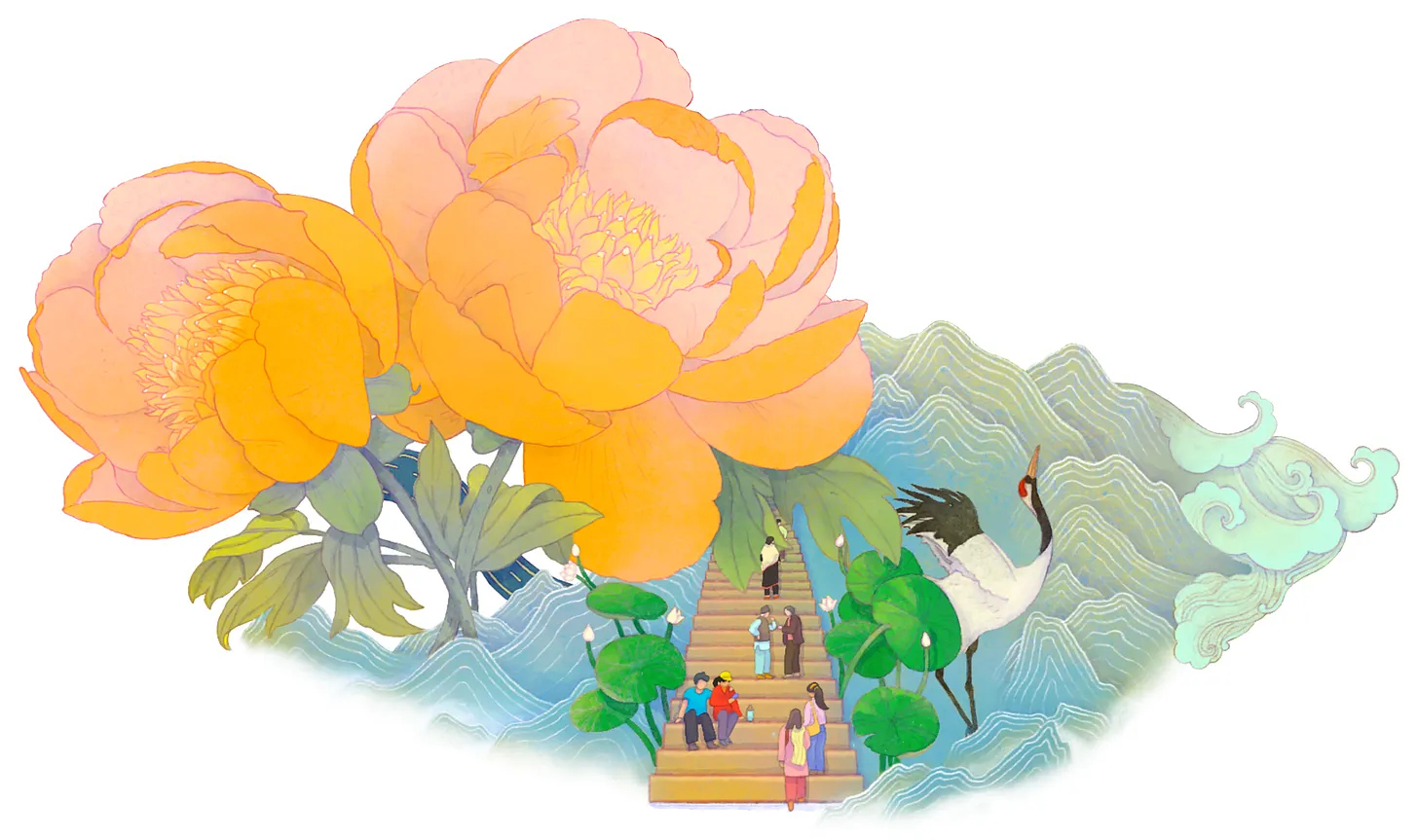
From Nepal-China 101, NEF’s report on the Nepal-China relationship. Illustration by
Ubahang Nembang.