The floods, the economy, and what comes next
A note from Sujeev

Sujeev Shakya, CEO, beed
The resilience of the Nepali people is tested again and again. We were settling into the new government formed in late March, preparing to implement its programs and projects from mid-July, the start of the new fiscal year. New policies were being announced and laws drafted. Then, on August 26, a Himalayan tsunami struck.
Thousands died. Thousands are still missing. Thousands more have been uprooted from their homes. Barely a year after the September uprising, another shock has fallen on the same people and the same economy. No dashboard or statistic can hold what has been lost, and it would be wrong to move past it too quickly. Whole communities along the river are grieving, and the work of recovery will be long.
What I can say is that Nepal did not face it alone, and did not face it as it once would have. The country drew on tremendous international goodwill, and relief poured in. There was a real departure from the past in how the government functioned. For those comparing it with the 2015 earthquake, functional local governments and an efficient federal machinery under a unified command delivered rescue and relief far faster. Thousands of helicopter flights airdropped essentials, moved technicians, and rescued the stranded. There was trust in the Prime Minister’s Relief Fund, with Nepalis around the world and friends of Nepal sending money to it, and a real-time dashboard showing what was collected and spent. By the standards of past disasters, the response was notably faster and more transparent.
The disaster also brought international media and agencies to Nepal, and they came to see the scale accurately. It hit three of the seventy-seven districts, accounting for 6% of our trade with China, 3% of tourism, and 10% of hydropower generation. The loss is grievous, but it is not the whole country. Those who had last covered Nepal after the 2015 earthquake saw how much has changed, the economic and political transformation I have spent these years tracking and sharing around the world.
Two decisions this quarter point to that change. The Chief Executive Officer of Investment Board Nepal was appointed through open competition, with Yanki Ukyab selected on merit. And ambassadors to eleven countries were chosen from more than 3,000 applicants, heralding a new era of merit-based appointment. Both send a positive signal to investors at home and abroad.
What we did
GIZ GRAPE II: a knowledge base for Nepal’s SMEs
For GIZ, under its Green Resilient Agricultural-Centered Private Sector Economic Development (GRAPE II) programme, we built the content framework and a working prototype for a business information database, a single, structured knowledge base that supports a small enterprise at every stage, from starting up to exporting.
The gap it fills is one every Nepali entrepreneur knows. To make sound decisions, an SME needs reliable information across the whole business lifecycle: how to register and comply, how to reach finance and insurance, how to get certified, how to manage supply and distribution, and how to find and enter a market. In practice that information is scattered across institutions, often unwritten, and hardest to reach for rural, early-stage, and women- and youth-led businesses. Most entrepreneurs fall back on informal networks and trial and error.
We organized the content across four domains, legal and regulatory compliance, finance, operations, and markets, mapped against every stage from seed to export. To ground it, we ran 103 key informant interviews across all seven provinces, testing the process on paper against the process in practice.
The information existed. It was just scattered, unwritten, and different in every province.
What we delivered pulls the full business lifecycle, from registration and tax to certification, finance, and export, into one plain-language knowledge base, supported by practical directories and a working digital mock-up, Nepal’s Business Compliance Hub. It sits in a working digital mock-up, Nepal’s Business Compliance Hub, and arrives as the government moves on its own single-window reform, one-day registration with an automatic PAN, the direction the database is built to support.
Guest voice: Tom Schneider
Turning bills into outcomes: what reform takes after the law is passed
A guest post by Tom Schneider, Setu Advisory
As it seeks to rebuild from the floods, Nepal doesn’t have a shortage of good economic ideas. In fact, it has a backlog of 50 pieces of legislation tied to economic reform pending, waiting to become something a citizen or a business experiences.
The challenge is implementation. The Government must pivot from the what to the how.
Of course, not every reform is primarily an implementation challenge. Some, like the pending Nepal Rastra Bank Act amendment, currently stalled over the Finance Secretary’s role on the board, involve institutional questions that must be resolved before any implementation work can start. For others, success depends on processes that work consistently, every day, for millions of businesses and citizens, often enabled by effective digital delivery.
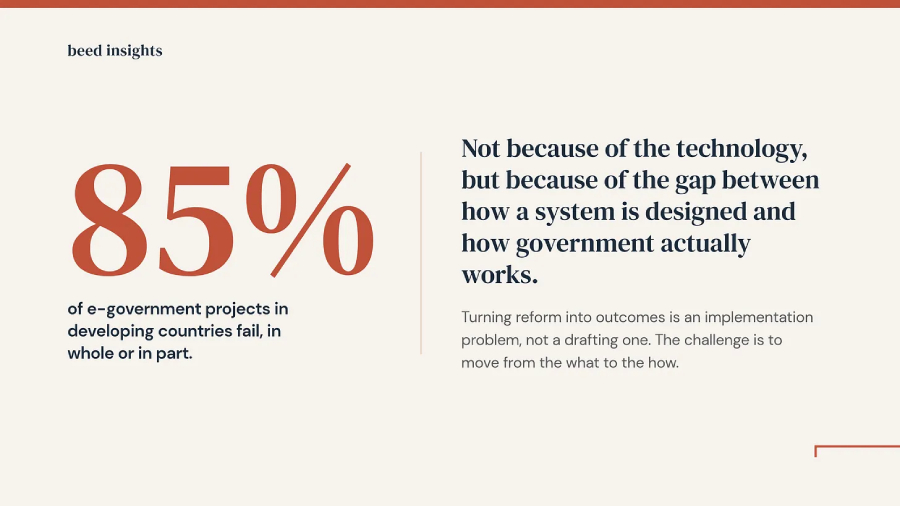
Research into e-government reform found that 85% of projects in developing countries fail, totally or partially, not because of bad technology, but because of the gap between how a system is designed and how government works. One response is business process re-engineering (BPR): the systematic work of bridging the gap between a policy destination and operational reality. It redesigns how government interacts with citizens and businesses, prepares organisations to work differently, and helps ensure technology delivers policy intent rather than simply digitising existing inefficiencies. It’s the sort of work I’ve spent many years doing, advising UK Government departments on programmes that succeeded, and some that didn’t.
Having relocated to Kathmandu with my wife, who is a British diplomat, I’m fascinated by how approaches like this might translate to Nepal’s own context.
I’ll set out some illustrative benefits of this approach using the recently passed Customs Reforms. Changes like this matter because they sit close to the economy itself. Every importer, exporter and logistics provider touches the customs system, meaning small improvements in service delivery can scale across millions of transactions.
- Focus effort where it matters most: the Bill highlights electronic declarations and National Single Window exchanges to reduce duplications, but BPR work would map what’s happening now and evaluate which approvals create the biggest delays, where information is entered more than once, and which process variations create unnecessary complexity. Assessed for impact, we quickly have greater clarity about where implementation effort should focus.
- Translate legislation into an operational service: the Bill talks about electronic declarations and a single window, but implementation requires decisions about training, regulatory updates, operational responsibilities and system functionality long before the service can go live.
- Reduce the risk of failure: changes like this involve hundreds of interdependent decisions, and delays in one area can stall progress elsewhere. Effective implementation requires a clear plan, robust governance and early testing through pilots to resolve issues before they become programme-level risks.What I don’t yet know is which of these factors matter most in practice in Nepal. I’ve set out some differences that strike me as a newcomer, but please get in touch to tell me what other contextual differences exist, including whether near-constant secretary rotation, which has run close to nine months on average historically, is still as sharp a constraint as it once was.
- Nepal’s federal system: any implementation programme would need to examine competing claims for authority at the outset and develop a collaborative decision-making model. The stakeholder responsible for delivery may not be the one empowered to resolve trade-offs.
- A lack of existing digitization: the UK is ranked 7th of 193 countries in the UN’s E-Government Development Index, whereas Nepal ranks 119th. Nepal is rising, having been 125th in the last survey, but implementation would need to recognise that digital maturity starts from a different baseline.
- Donor funding: historically, customs modernisation has relied heavily on donor support, so any implementation programme would need to account for donor procurement requirements, assurance processes and reporting expectations from the outset.
Nepal’s best chance of turning Bills into economic outcomes is to embrace the global policy implementation playbook while adapting it thoroughly for local context. The Bills already describe a Nepal that would feel materially better for citizens and businesses. The challenge now is not defining those outcomes, but translating them into services, processes and institutions capable of delivering them consistently.
Tom Schneider is founder of Setu Advisory and has spent a decade advising UK central government on strategy and institution-building. He is now based in Kathmandu.
What we’re watching
The Prime Minister’s first foreign trip was not a search for relief. It was a speech at the United Nations, and it carried a message that reached past the disaster: Nepal is not an aid-dependent country. Aid is less than 3% of GDP. This is a country of 30 million people, land-linked to markets of nearly 2.8 billion people in India and China, that needs investment, technology transfer, and global attention to grow at pace and with equity.
That message is starting to land. International coverage has moved beyond the floods, the New York Times wrote on Nepal’s Gen Z taking on the world’s polluters over climate change. High-level visits from governments and the global business community have already begun, with more planned.
The next quarter will be busier still. State visits are planned for the Prime Minister to India and China, and the pitch for investment has already started, with the Finance Minister traveling to India and to the Asian Infrastructure Investment Bank (AIIB) meeting. We expect further movement on reform, in policy, institutional mechanisms, and legislation.
We remain hopeful about the direction, and our research thought center, Nepal Economic Forum, continues to track it closely.
From the network
- Article: Why the Bhotekoshi flood happened, ICIMOD. A reconstruction of the August 26 disaster, traced to an ice-and-rock avalanche on the Nepal-China border rather than a glacial lake, and the early-warning gaps that left communities downstream with no alert.
- Article: Growth to jobs in South Asia, World Bank. On whether industrial policy can turn the region’s growth into the jobs it needs, and what kind of policy actually works.
- Talk: Sujeev at the 40th Liberty International World Conference in Kathmandu, on Nepal as land-connected rather than landlocked.
- Video: Sujeev in conversation with Ambassador Danielle Meuwly at Asia Society Switzerland, moderated by Rosina Adathala.

Sujeev Shakya in conversation with Ambassador Danielle Meuwly at Asia Society
Switzerland, Zurich. Photo courtesy of Asia Society Switzerland.
- Book launch: A revised edition of Nepal 2043: Road to Prosperity, with a new chapter, “A Year That Felt Like a Decade,” launched in Madrid with Casa Asia and the Embassy of Nepal, Spain.
- Podcast: Sujeev on the Endgame podcast with Gita Wirjawan, on the Gen Z protests and what they mean for Nepal.
- Book: The Once and Future World Order by Amitav Acharya, recommended by Sujeev, on why the future of the global order will be shaped well beyond the West.
- Audiobook: Global Citizen from Gulmi by Kul Chandra Gautam, from a village in Gulmi to the senior ranks of the United Nations, now available to listen to.
NEF resources
Nepal Economic Forum (NEF) publishes regular analysis on Nepal’s economy, policy, and budget. Founded in 2009 as a not-for-profit organization under the beed umbrella, NEF works closely with beed on policy research and economic analysis. A few updates from this quarter:
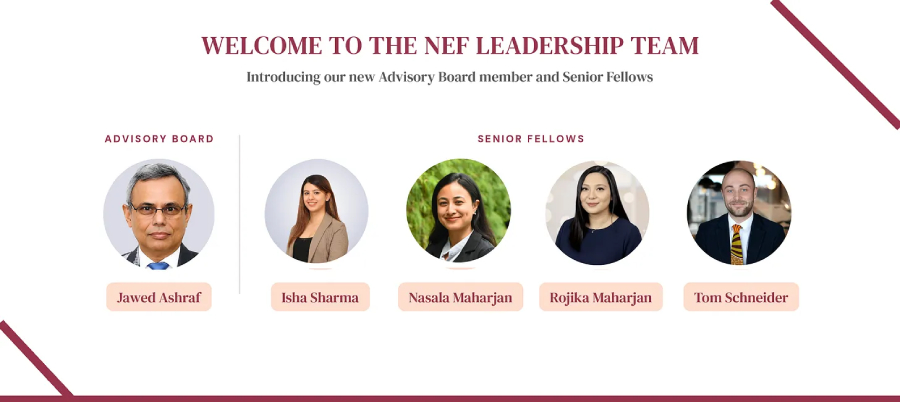
NEF welcomed a new Advisory Board member and four new Senior Fellows this fiscal year: Ambassador Jawed Ashraf joins the Advisory Board, and Isha Sharma, Nasala Maharjan, Rojika Maharjan, and Tom Schneider join as Senior Fellows.
NEFport, NEF’s flagship publication, released its 66th edition on Digital Democracy, examining how digital platforms and emerging tools are shaping participation, public discourse, and governance in Nepal. [Read NEFport 66]
NEF has continued its dissemination-first work across social media, with explainers on the floods covering Nepal’s disaster response system [View on Instagram] and the sectoral damage from the Bhotekoshi floods [View on Instagram].
To access the full archive and subscribe directly, find NEF on Substack.
Dashain
As we close, Dashain is upon us, and it arrives this year in a subdued key. For many families along the Bhotekoshi and beyond, the festival will be marked by an empty place, and our thoughts stay with them.
Still, Dashain is when Nepal comes home. Families reunite, people take a rare pause, and businesses look to the season that carries a large share of the year’s trade. That rhythm has been disrupted this year, and the recovery ahead will test it. We hold both at once: grief for what has been lost, and the quiet hope the festival has always carried.
From all of us at beed, our wishes for a safe and reflective Dashain.